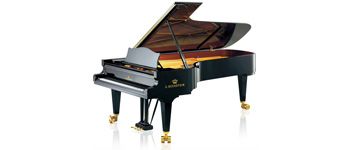
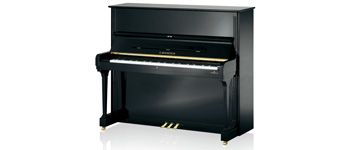
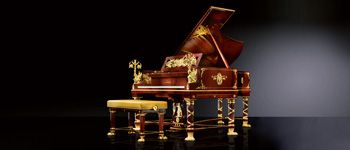





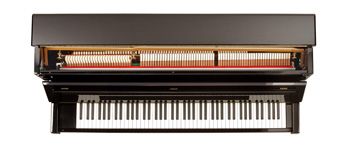


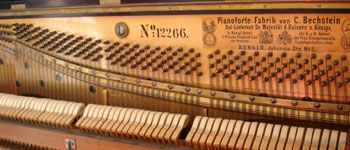


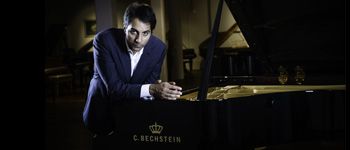

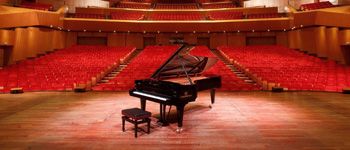
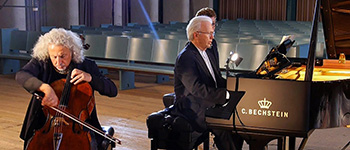



The golden age of the piano: in the 19th century, mobile phones, computers, television, radio and stereo systems played no role. People attended concerts and made music themselves — and the piano began its triumphant rise in middle-class households. In the second half of the 19th century, around 200 piano-making companies in Berlin satisfied the enormous demand. But only one manufactory has survived: C. Bechstein.
When 27-year-old Carl Bechstein founded his own workshop in Berlin in 1853, probably no one suspected that he was laying the foundation for a “resounding myth”. Yet he had the very best prerequisites for success as a piano maker. He was not only a brilliant craftsman, but also understood his target audience: musicians. And the man who would later become an enormously successful businessman must also have had a strong command of numbers.
Carl Bechstein was born in Gotha on 1 June 1826. His father, a cousin of the fairy-tale collector Ludwig Bechstein, died in 1831 at the age of 42. Carl Bechstein received solid instruction in violin, cello and piano from his stepfather. At the age of 14, Carl was sent to Erfurt to train under the piano maker Johann Gleitz. After four years, he turned his apprenticeship into travelling years, first going to Dresden and Berlin, and from 1849 onwards also to London and Paris, in order to learn from the finest piano makers of his time.
Bechstein could no longer have met Sébastien Érard, who had died in 1831. Whether he met Érard’s nephew and successor, Pierre Érard, in Paris is not documented. But Carl Bechstein appears to have learned from Érard how important artists were for the marketing of a piano-making company. In 1856, Bechstein also witnessed Érard providing Liszt with a grand piano for a concert in Berlin. And Bechstein saw how, over the course of the evening, one string after another failed to withstand the strain of Liszt’s highly virtuosic piano playing and snapped. It was then that Bechstein resolved to build a new, truly modern grand piano — one that would withstand even Liszt’s playing.
The decisive concert took place on 22 January 1857: Hans von Bülow gave the world première of Liszt’s Piano Sonata in B minor in Berlin. The sonata divided opinion, sparking a significant feud in the press, during which Hans von Bülow firmly defended the work. He was equally convinced that it was above all the new instrument he had used that had helped the sonata achieve its impact. The day after the concert, Bülow wrote a letter to Liszt in which he mentioned that he had played an instrument by “a certain Bechstein”, which he rated more highly than the Érards.
Hans von Bülow later described Bechstein’s instruments as being to pianists what “Stradivarius and Amati are to violinists”. Debussy believed that piano music should be written only for the Bechstein. Composers from Alexander Scriabin and Ferruccio Busoni to Richard Strauss loved their Bechstein. From around 1860, Bechstein also supplied royal courts — first the Prussian court, later also Great Britain — and proudly inscribed the title “Hoflieferant” (Purveyor to the Court) on his grand pianos. Yet Bechstein was not famous only for his grand pianos: while others still relied on the square piano, once so widespread, he energetically focused his manufactory on upright pianos. The Bechstein conquered the drawing rooms and music rooms of the middle classes, and Carl Bechstein expanded his production sites several times.
On 4 October 1892, to the greatest pride of Carl Bechstein — who by then was entitled to call himself a Privy Councillor of Commerce — the “Bechstein-Saal” opened in Linkstraße. The three opening concerts were given by Hans von Bülow, Johannes Brahms and Anton Rubinstein. Carl Bechstein did not live to see the opening of Bechstein Hall, today’s Wigmore Hall, by Ferruccio Busoni in London in 1901. When Carl Bechstein died on 6 March 1900, he left his three sons a global company with almost 800 employees, producing more than 3,500 instruments per year.
Today, C. Bechstein still remains a Berlin-based company and Europe’s largest piano manufacturer. Around 400 employees work for C. Bechstein in two manufactories in Seifhennersdorf, Saxony, and Hradec Králové in the Czech Republic, as well as in 14 company-owned C. Bechstein Centres in Germany and Austria, and through its own distributors in the USA, Japan and China. They all congratulate their company founder, who is said to have spoken of himself with great modesty: “I simply had the fabulous good fortune that God stood at my workbench.”
Press contact
Gregor Willmes, Tel. +49 1590 4548 323, willmes@bechstein.de
Text and photos may be used free of charge.
Photo credit: C. Bechstein Archive