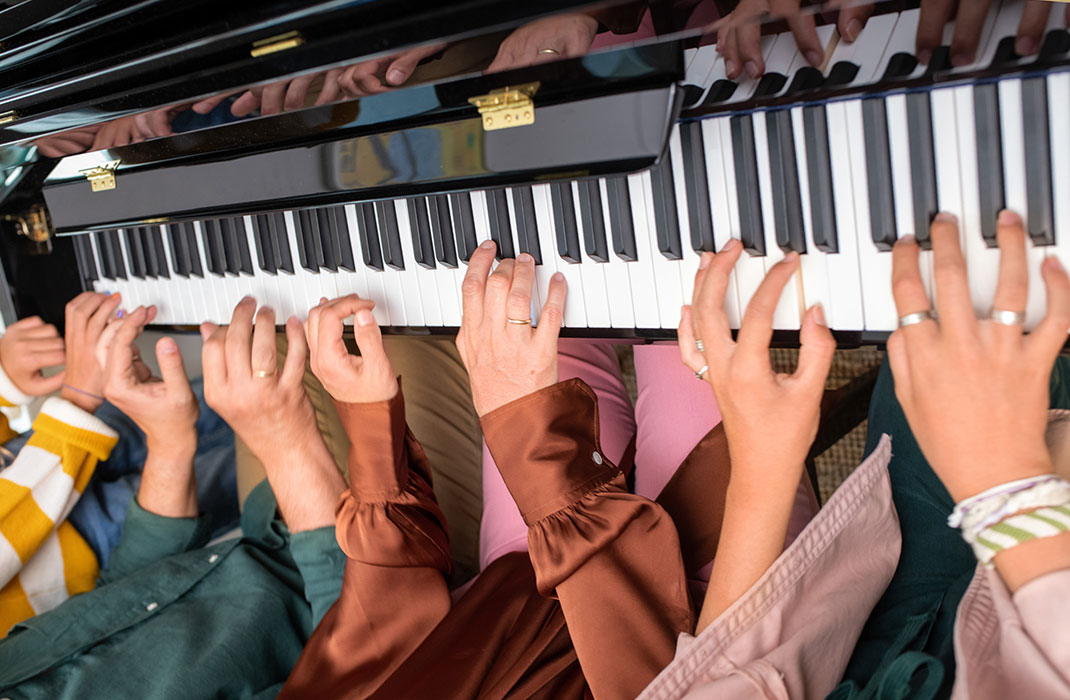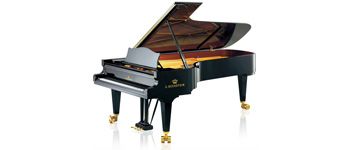














C. Bechstein now offers grand pianos from the Concert Series also with narrower keys. Like the models with standard keyboards, these pianos also feature MIDI connectivity and can optionally be equipped with the VARIO silent system.
Keyboards with narrower keys have recently been attracting growing interest and becoming increasingly widespread. Until just a few years ago, the topic was something of a niche interest in the piano world. Today, however, more and more people and institutions are opting for grand and upright pianos with smaller key measures.
The SIRIUS 6.0 future initiative (Zukunftsinitiative SIRIUS 6.0) at the University of Music and Performing Arts in Stuttgart provides an overview of this recent success story. Ulrike Wohlwender, Professor of Piano Pedagogy, and her colleague, the pianist Silvia Molan, are working intensively on this subject at the HMDK Stuttgart and have essentially contributed to C. Bechstein’s engagement in this field.
Currently, C. Bechstein is introducing the first grand piano (Concert A-192 model) featuring a 6.0 keyboard and matching MIDI sensor technology. The highly sensitive sensor strip beneath the keys, part of the proven C. Bechstein Connect technology which measures key velocity contactlessly using infrared light, has been adapted to the narrower keyboard for this purpose.
This technology not only provides the numerous benefits already associated with the C. Bechstein Connect system – such as controlling music notation software, digital audio workstations (DAW) and any type of MIDI-compatible software. It also enables the highly sensitive data capture for further scientific research. This helps to bring the long-term vision closer to reality: establishing narrower keyboards as a standard alternative to conventional keyboards and thereby contributing to greater equality of opportunity in piano performance.
.
If you are interested in a C. Bechstein grand piano with narrower keys, please email us at: narrowkeys@bechstein.de
The advantages of narrower keyboards are obvious: as numerous studies have shown, most people with small to medium-sized hands find narrower keys easier to play. The main benefit – leading to a range of further advantages (see below) – essentially lies in the improved and easier playability of large intervals, leaps and wide-spanning chords, as Ulrike Wohlwender and Silvia Molan convincingly demonstrate in their foundational text „SIRIUS 6.0 – Klaviaturen, die Hände wachsen lassen“ (“Keyboards that let your hands grow“; available on the website mentioned above) and on whose findings we primarily refer here.
The standard measurement for piano keyboards of 6.5 inches (= 165 mm) per octave – measured across the total width of seven white lower keys – which is now established as global standard, was only internationally standardised around 1880. The average size of Central European men’s hands was presumably the decisive factor in standardising the key width to 22 mm.
Hand span studies from Australia confirm the hand research of music medicine specialist Christoph Wagner: On a standard keyboard, men on an average reach a tenth, whereas women can typically only reach an average ninth. In addition to gender-specific differences, other factors come into play. For instance, pianists of Asian descent, who today make up the majority of piano students at music conservatories worldwide, tend to have narrower hands and smaller hand spans than, for example, pianists with Central European roots.
It goes without saying that children, with their naturally smaller hands, also benefit from narrower keyboards – comparable to the string instruments that have always been readily available to them as a matter of course in various age-specific sizes.
Considering all these groups mentioned above together, we can conclude that narrower keyboards could be a relief for a great many, possibly even the majority of piano players, because the reduced key width suits them ergonomically. Studies on the subject appear to confirm this: For around „87% of women and 24% of men“ – according to Wohlwender/Molan, citing international research findings – standard keyboards are actually too large for a wide-reaching repertoire.
Conversely, this implies that people with smaller hands are professionally disadvantaged in the piano world compared to those with larger hands. This is evident, for example, in piano competitions: Men win first prizes four times more often than women when a wide-range repertoire is required. In Bach and Mozart competitions, the opposite is true. Could the gender gap in piano competitions perhaps even be largely attributed to keyboard size?
The most frequently expressed concerns regarding narrower keyboards are the presumed or feared difficulties of adaptation, that is, getting used to and switching from one key size to another. However, all studies on this question known to date come to the opposite conclusion: Normally – and contrary to expectations – changing keyboard size in either direction poses practically little to no difficulty. Most participants adapt to the altered key dimensions within just a few minutes. In addition to the research findings of Wohlwender/Molan, this is also confirmed by the results of the recently published study by Prof. Ulrich Hench at the Nuremberg University of Music.
Before the introduction of the standard keyboard in the second half of the 19th century, the ability to adapt to different keyboard sizes was part of the everyday challenges for all pianists who played on different instruments. Until then, the keys of historical fortepianos varied in width from instrument to instrument, as one can experience first-hand, for example, in the collection of historical keyboard instruments at the Carl Bechstein Foundation in Berlin. Variations of up to 9.4 mm per octave were commonplace, with the average key width – and thus the octave width – increasing as instruments became larger and more stable throughout the history of piano making.
Since the standardisation introduced around 1880, the fixed octave measurement was at first hardly questioned for a long time. Josef Hofmann was the first pianist to perform on a grand piano with narrower keys from 1930 onwards, for which he had already drawn up plans in 1911. It was not until the 1990s that the American engineer and entrepreneur David Steinbuhler (Pennsylvania, USA) began building keyboards with alternative key widths. The most famous pianist who at present openly plays on narrower keys is Daniel Barenboim. Since 2008, Barenboim has been playing on a keyboard with a key width of 6.2 inches (157.5 mm instead of 165.1 mm). His grand piano by Chris Maene, completed in 2015 – a so-called straight-strung instrument without cross-strung strings, built on the model of a historic C. Bechstein grand piano – also features narrower keys.
In the English-speaking world, pianist and piano professor Dr. Carol Leone (Dallas) initiated research and dissemination of 6.0 keyboards at American universities. Together with Rhonda Boyle and Erica Booker (Sydney), she founded the network Pianists for Alternatively Sized Keyboards (PASK) in 2013. Since around 2020, the movement has also been gaining momentum in German-speaking countries, largely thanks to the efforts of Ulrike Wohlwender and Silvia Molan, who installed the first grand piano with narrower keys at a German music academy at the Stuttgart University of Music and Performing Arts (HMDK Stuttgart) and on site founded the SIRIUS 6.0 initiative.
Meanwhile, „SIRIUS 6.0“ has now become synonymous with narrower keys in the German-speaking piano world in generell. Instruments with SIRIUS 6.0 keyboards can now be found at the conservatoires in Stuttgart, Nuremberg, Innsbruck and Munich. And the number continues to grow.
In 2021, New York pianist Hannah Reimann founded the annual International Stretto Piano Festival, featuring online and live in-person concerts worldwide on upright and grand pianos with narrower keyboards. Stretto (Italian for “narrow”) keys or keyboards is, alongside the terms “narrow” resp. “narrower keys”, the technical term commonly used in the English-speaking world for smaller keys.
Looking ahead, we can therefore expect the slow but steady trend towards narrower keyboards to attract more and more followers. Scientific research is also on the rise. In addition to the projects already mentioned at the HMDK Stuttgart and the HfM Nuremberg, reference should be made to an important current research project by Dr. Florian Worschech at the HMTM Hannover, entitled “Kleine Tasten, große Wirkung” ("Small Keys, Big Impact"), which investigates adaptation when switching between different keyboard sizes.
Even pianists with larger hands can benefit from narrower keyboards. Many players even report that they can transfer some of the ease they experience when playing on the narrower keyboard to the standard keyboard, as Prof. Ulrich Hench reports in the study mentioned above.
Finally, here is a list of the advantages of narrower keyboards most frequently cited in the specialist literature:
• reduced effort and fatigue during practice
• less tension and cramping
• prevention of playing-related overuse syndromes (e.g. tendonitis)
• better control and precision in sound shaping
• a finer, more balanced tone and a more nuanced sound overall
• more efficient practice in generell
• greater focus on interpretation
• greater equality of opportunity in professional development
• greater equality of opportunity in competitions
• gender equality
• age equality